The Certified Pharmacy Technician (CPhT) Exam is a key step for pharmacy technicians aiming to boost their careers. The 2026 exam has new updates focusing on clinical application and federal compliance, replacing rote memorization. Here’s what you need to know:
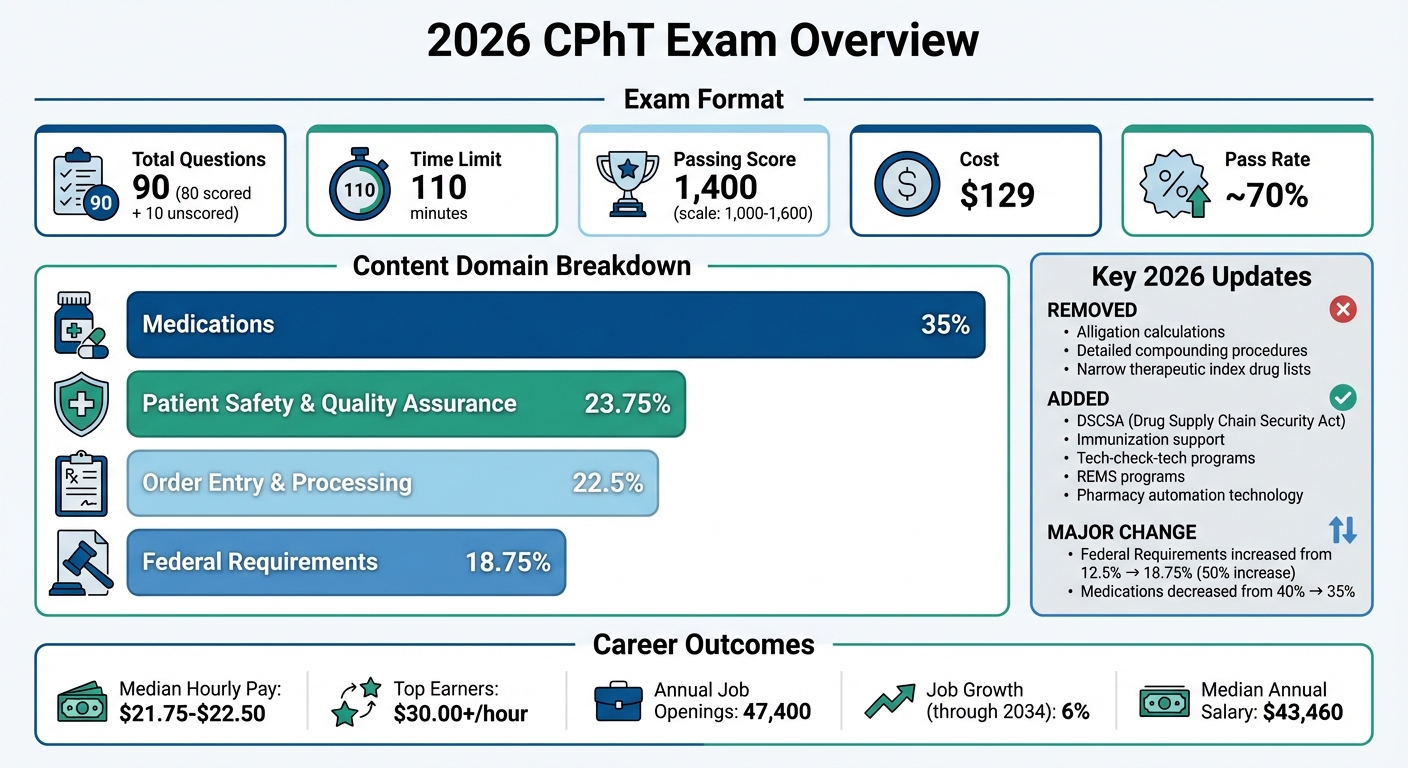
- Exam Changes: The Federal Requirements domain now accounts for 18.75% of the test, with topics like the Drug Supply Chain Security Act (DSCSA) and track-and-trace protocols. Alligation calculations and some compounding procedures have been removed.
- Format: 90 questions (80 scored, 10 unscored), completed in 110 minutes. New interactive formats like "Hot Spot" and "Drag-and-Drop" are included.
- Content Breakdown:
- Medications: 35%
- Federal Requirements: 18.75%
- Patient Safety & Quality Assurance: 23.75%
- Order Entry & Processing: 22.5%
- Passing Score: 1,400 on a scale of 1,000–1,600.
- Cost: $129 application fee.
Certified pharmacy technicians earn $21.75–$22.50 per hour on average, with top earners making over $30.00/hour. The demand remains strong, with 47,400 job openings annually and a projected 6% growth through 2034. Preparation options include online programs with interactive tools, timed practice exams, and study guides tailored to the updated blueprint.
The exam is a stepping stone to higher-paying roles, especially in clinical or hospital settings. Ready to get started? Dive into the updated domains and focus on practice questions to ensure success.
2026 CPhT Exam Content Breakdown and Domain Weights
What to Expect on the PTCE in 2026 – PTCB‘s CPhT Exam Content Outline Update | Amanda PharmD
sbb-itb-7a67ffa
2026 CPhT Exam Format and Updates
This section dives into the updated format and revisions for the 2026 CPhT exam, giving you a clear picture of what to expect.
Exam Structure and Key Details
The Pharmacy Technician Certification Exam (PTCE) is administered exclusively at Pearson VUE testing centers starting in 2026 – online proctoring is no longer an option. The test includes 90 multiple-choice questions, of which 80 are scored and 10 are pretest items. You’ll have 110 minutes to complete the exam, with an additional 10 minutes for a tutorial and post-exam survey, making the total session 120 minutes. Scoring is based on a scale of 1,000 to 1,600, and a minimum score of 1,400 is required to pass. Historically, about 70% of test-takers pass the exam.
New for 2026 are interactive question formats. These include multiple-response questions (choose all correct answers), hot spot questions (click on specific areas of an image), drag-and-drop tasks, and case-based question sets. Keep in mind, there’s no partial credit awarded for these interactive formats.
Major Updates to the 2026 Exam Blueprint
As of January 6, 2026, the exam blueprint has undergone major changes. The Federal Requirements domain now makes up 18.75% of the exam, a 50% increase from its previous weight of 12.5%. This shift places more focus on regulatory compliance and supply chain security. On the other hand, the Medications domain has been reduced from 40% to 35%, signaling less emphasis on memorizing drug facts.
Several topics have been removed, including detailed compounding procedures, alligation calculations, and narrow therapeutic index drug lists. If you’ve been studying standards like USP <795> and <797> or practicing alligation math, it’s time to redirect your efforts. The exam now emphasizes the Drug Supply Chain Security Act (DSCSA), particularly the "3 Ts" – Transaction Information, Transaction History, and Transaction Statement. Pharmacies must also maintain transaction records for six years.
New content areas include immunization support, tech-check-tech programs, DEA Form 222 procedures, REMS programs, and pharmacy automation technology. These additions reflect the growing clinical responsibilities of pharmacy technicians.
PTCE vs. ExCPT Comparison
Both the PTCE (administered by PTCB) and the ExCPT (administered by NHA) lead to national certification, but they cater to different career paths. The PTCE is often seen as the preferred choice for hospital and clinical roles, while the ExCPT aligns more with retail pharmacy workflows.
| Feature | PTCE (PTCB) | ExCPT (NHA) |
|---|---|---|
| Total Questions | 90 (80 scored) | 120 (100 scored) |
| Time Limit | 110 minutes | 130 minutes |
| Cost | $129 | $129 |
| Passing Score | 1,400 (scale 1,000–1,600) | 390 (scale 200–500) |
| Work Experience Eligibility | 500 hours | 1,200 hours |
| Primary Focus | Clinical, Law, Safety | Retail Workflow, Dispensing |
| Testing Center | Pearson VUE | PSI |
The PTCE’s lower work-experience requirement (500 hours compared to 1,200 hours for the ExCPT) makes it more accessible for those transitioning into pharmacy roles. Additionally, hospital positions requiring PTCB certification come with a median annual salary of $49,310, which is over $11,000 more than the $37,900 median for retail roles. If you’re aiming for a clinical or hospital setting, the PTCE is the better option. However, if your employer specifically requires the ExCPT or covers its cost, that might influence your decision.
Next, we’ll dive into the core knowledge areas you’ll need to master for the 2026 CPhT exam.
Core Knowledge Areas for the 2026 CPhT Exam
The 2026 PTCE focuses on four main knowledge domains, which mirror the evolving responsibilities of pharmacy technicians. Excelling in these areas is essential for organizing your study efforts effectively. According to the PTCB, the updated content places greater emphasis on patient safety, regulatory compliance, pharmacology, and medication management.
Here’s how the exam is structured for 2026:
| Knowledge Domain | 2026 Weight | Key Focus |
|---|---|---|
| Medications | 35% | Top 200–300 drugs, therapeutic classes, indications |
| Federal Requirements | 18.75% | DEA schedules, DSCSA, recordkeeping |
| Patient Safety & Quality Assurance | 23.75% | Error prevention, high-alert medications, LASA drugs |
| Order Entry & Processing | 22.5% | Prescription interpretation, calculations, billing |
Plan your study time based on these weightings. For instance, if you have 10 hours to prepare, spend about 3.5 hours on Medications and roughly 1.9 hours on Federal Requirements. With this breakdown in mind, let’s dive into the specifics of each domain.
Medications Domain
Accounting for 35% of the exam, the Medications domain remains the most critical. However, it’s not just about memorizing drug facts. Focus on the Top 200–300 drugs, including their brand and generic names, therapeutic classifications, indications, mechanisms of action, and common side effects.
Pay attention to drug suffix patterns (e.g., -pril for ACE inhibitors, -sartan for ARBs, -olol for beta-blockers). This knowledge will also tie into essential calculation skills you’ll need for the test.
Dosage calculations are a must. Practice solving problems involving ratio-proportion, dimensional analysis, and days’ supply for items like inhalers and liquids. IV flow rate calculations are another key area. While alligation problems have been removed from the 2026 blueprint, basic pharmacy math remains a core skill. Daily practice with these calculations, especially for insulin pens and inhalers, can help you feel confident on exam day.
Don’t forget standard storage requirements:
- Room temperature: 68–77°F (20–25°C)
- Refrigerator: 36–46°F (2–8°C)
- Freezer: -13 to 14°F (-25 to -10°C)
Federal Requirements and Pharmacy Law
This domain makes up 18.75% of the exam and emphasizes regulatory compliance and supply chain security. A key focus is the "3 Ts" of the DSCSA: Transaction Information (TI), Transaction History (TH), and Transaction Statement (TS). Pharmacies must keep transaction records for six years under federal law. Serialization topics, like understanding the National Drug Code (NDC), serial numbers, lot numbers, and expiration dates, are highly testable.
You’ll also need a solid understanding of DEA schedules and procedures. Familiarize yourself with DEA forms:
- Form 222: Ordering Schedule II drugs
- Form 106: Reporting theft or loss
- Form 41: Destruction of controlled substances
Know the rules for Schedule II drugs (e.g., no refills, written or electronic prescriptions required) and the refill limits for Schedule III–V drugs (up to five refills within six months).
Practice DEA number verification:
- Add the 1st, 3rd, and 5th digits.
- Add the 2nd, 4th, and 6th digits, then double this sum.
- The last digit of the total should match the DEA number’s 7th digit.
Patient Safety and Quality Assurance
With a weight of 23.75%, this domain emphasizes error prevention and systems that protect patients. Focus on strategies like recognizing high-alert medications, understanding LASA (look-alike, sound-alike) drugs, and using barcode scanning and automation in pharmacy workflows.
Study the ISMP list of high-alert medications, which includes drugs like insulin, anticoagulants, and chemotherapy agents. Although the Narrow Therapeutic Index (NTI) drug list has been removed from the 2026 blueprint, ISMP guidelines remain vital.
You’ll also need to understand adverse event reporting. Familiarize yourself with MedWatch, the FDA’s reporting system, and learn the basics of root cause analysis for investigating medication errors. Additional topics include documentation standards, tech-check-tech programs, and automated dispensing systems, reflecting the growing role of technology in pharmacy operations.
Step-by-Step Study Plan for the 2026 CPhT Exam
Creating Your Study Timeline
Using the latest exam blueprint as your guide, map out a study timeline that fits your schedule. Experts recommend dedicating between 80 and 120 hours to prepare thoroughly. If you can commit to studying 2–3 hours a day, six days a week, an 8-week plan is a solid choice. For those with a strong pharmacy background, a 6-week plan with 3–4 hours of study each day might be more efficient. On the other hand, if you’re working full-time or need extra review time, a 12–14-week plan with 1.5–2 hours of daily study could be more realistic.
Start by setting your exam date and working backward to build your timeline. Distribute your study time according to the exam’s domain weights: around 35% for Medications, 23.75% for Patient Safety and Quality Assurance, 22.5% for Order Entry and Processing, and 18.75% for Federal Requirements. Plan a decision date two weeks before your 90-day authorization expires – if your practice test scores are under 80%, consider purchasing the $20 extension.
Once you’ve mapped out your overall timeline, break it into manageable weekly goals.
Weekly Study Breakdown
In the first two weeks, focus entirely on the Medications domain. Review the Top 200 drugs, their therapeutic classes, and commonly used drug suffixes like –olol and –pril. Shift your attention in week three to Patient Safety and Quality Assurance, emphasizing strategies for error prevention, Tall Man lettering, and USP standards. Week four should center on Federal Requirements, including DEA schedules, HIPAA regulations, and the updated 2026 DSCSA tracking guidelines.
During week five, dive into Order Entry and Processing by studying SIG codes, NDC numbers, and insurance billing procedures. Use week six to strengthen your pharmacy math skills, focusing on dosage calculations, IV flow rates, and determining days’ supply. For the final two weeks, prioritize full-length timed practice exams and concentrate on improving weak areas.
Once your weekly goals are set, develop a daily routine to stay on track.
Daily Study Routines
Start each day with 15–20 minutes of flashcards to review the brand and generic names of the Top 200 drugs. Spend another 10–15 minutes solving 5–10 pharmacy math problems to stay sharp with conversions and dosage formulas. Dedicate the bulk of your study time to a specific domain, taking detailed notes and completing practice questions.
In your final two weeks, focus on building test stamina by completing 3–5 full-length timed mock exams. Keep a log of look-alike/sound-alike drugs and review any mistakes from practice questions weekly. During the last week, avoid tackling new material. Instead, stick to light reviews of essential formulas and high-yield topics to avoid burnout.
Resources and Tools for 2026 CPhT Exam Success
Once your study plan is set, the right resources can make a big difference in your exam preparation. Here’s a breakdown of tools to help you feel confident and ready.
Official PTCB Study Materials
The PTCB Practice Bank is a great starting point. It includes over 300 retired exam questions and a 400-card digital flashcard deck. For $65, you get 90 days of access to these materials. According to research, candidates who use this tool tend to score 10% higher on average.
Another option is the Pre-PTCE, a simulated exam designed to mimic the actual test experience. Priced at $29, it uses retired questions to give you a realistic preview of the test. Passing the Pre-PTCE significantly boosts your chances of success – those who pass are three times more likely to pass the actual exam. The PTCB emphasizes:
"The Pre-PTCE is intended as a final check of readiness after studying".
If you’re applying for the CPhT exam, you can bundle the Pre-PTCE with your application and save $10.
Beyond these official materials, digital tools can help you study wherever and whenever it’s convenient.
Flashcards, Apps, and Study Guides
Digital flashcards are especially helpful for memorizing drug suffixes like –olol for beta blockers or –pril for ACE inhibitors. Mobile apps are another great tool, allowing you to review SIG codes and the Top 200 drugs while on the go.
Make sure any study guides you use are updated for the 2026 exam blueprint. This means they should reflect changes like the removal of alligation calculations and narrow therapeutic index medications, while including new topics such as drug diversion and the DSCSA.
To stay on track, combine these tools with regular practice tests and question banks.
Practice Tests and Question Banks
Diagnostic tests are a great way to pinpoint weak areas. Aim for consistent practice scores above 80%. As you get closer to test day, try taking at least one full-length, 90-question practice exam. Simulate the test environment by completing it in a quiet space without notes. This will help you build the focus and endurance needed for the 2-hour exam.
High-quality question banks go beyond just providing answers – they include detailed explanations to help you grasp the concepts behind each question. Many also come with digital dashboards that track your progress, giving you a clear picture of your readiness. If your scores aren’t where you want them to be with two weeks left in your 90-day authorization window, you can purchase a $20 extension to give yourself more time to study.
Test Day Strategies and What Comes Next
Preparing for Test Day
The exam consists of 90 multiple-choice questions (80 of which are scored) to be completed in 110 minutes. Scores range from 1,000 to 1,600, with a passing score set at 1,400. This means you’ll need to average about 75 seconds per question. A good strategy is to aim for completing 45 questions by the halfway point – around 55 minutes.
To manage your time effectively, consider using the two-pass method. On the first pass, tackle the questions you find straightforward, spending no more than 20–30 seconds on each. Flag the tougher ones for review during your second pass. Be mindful of tricky phrasing, especially negative qualifiers like "NOT", "EXCEPT", and "FIRST", which can easily trip you up. Make sure to answer every question, even if you’re unsure. Eliminating wrong answers can improve your chances of guessing correctly.
Plan to arrive at the test center 30 minutes early. Check-in involves biometric scans and strict ID verification. If you feel nervous, try box breathing: inhale for 4 counts, hold for 4 counts, exhale for 4 counts, and hold again for 4 counts. This can help calm your mind. As CCI Training Center explains:
"When you are stressed, working memory decreases, decision-making slows, and simple questions feel impossible."
Don’t underestimate the importance of sleep the night before. A good night’s rest can significantly improve your ability to think clearly and make quick decisions.
Once test day is behind you, the focus shifts to certification and the next steps in your career.
After Passing: Certification and Career Steps
You’ll get an unofficial pass/fail result on your screen immediately after completing the exam. Official results will be posted to your PTCB account within one to three weeks. If you completed Pathway 1 (a PTCB-recognized training program), you’ll need to submit proof of completion – such as a certificate, transcript, or a letter from your training provider – before you can receive your certification.
Passing the exam is a major milestone, but it’s just the starting point for your career. Your certification opens up opportunities for better jobs and career advancement in pharmacy. Make sure to register with your State Board of Pharmacy, as requirements vary depending on where you live. To maintain your certification, you’ll need to renew it every two years by completing 20 hours of continuing education (CE). This must include at least one hour in pharmacy law and one hour in patient safety. Tools like the NABP CPE Monitor can help you track your CE credits.
Pharmacy technicians earned a median annual pay of $43,460 in 2024. The field is expected to grow by 6% through 2034, with approximately 49,000 job openings each year. Your CPhT credential qualifies you for positions in community pharmacies, hospitals, health systems, and specialty settings. As you gain experience, you might explore advanced credentials like CPhT-Adv or specialty certifications in areas such as sterile compounding (CSPT) or immunization support. These additional qualifications can help boost your earning potential and expand your career options.
FAQs
How should I adjust my study plan for the 2026 PTCE updates?
To get ready for the 2026 PTCE updates, shift your attention toward federal requirements, which now make up 18.75% of the exam. Make sure to dive into the new DSCSA traceability topics, as these are part of the updated content. On the flip side, you can cut back on studying compounding and alligation calculations since they’ve been removed from the exam.
It’s also a good idea to familiarize yourself with the new question formats – these include multiple-response, hot spot, and drag-and-drop types. Lastly, ensure your study materials reflect these updates to stay on track for effective preparation.
What DSCSA and DEA topics are most likely to show up on the exam?
The Drug Supply Chain Security Act (DSCSA) focuses on ensuring the safety and integrity of prescription drugs as they move through the supply chain. Key aspects include maintaining transaction information, transaction history, and implementing electronic tracking systems to monitor drugs from the manufacturer all the way to the pharmacy.
On the other hand, DEA regulations primarily deal with controlled substances. Topics often include understanding the scheduling of controlled substances, compliance with DEA rules, and the legal responsibilities tied to the handling and distribution of these medications.
How can I practice the new hot spot and drag-and-drop questions?
To get ready for the 2026 CPhT exam, make use of official PTCB practice tools. These resources feature over 300 questions designed to mirror the updated exam format, including interactive types like hot spot and drag-and-drop. These question styles might ask you to pinpoint specific areas on an image or match items correctly. Additionally, watching practice videos that cover high-yield questions can help you get comfortable with these formats and boost your confidence.